
Human Rights for LGBTIQ+
We advocate for human rights, in particular for the rights of women and girls as well as LGBTIQ+ people (lesbians, gays, bisexuals, transsexuals, transgender, intersex and queer people). In addition, we support measures and projects aimed at enforcing and strengthening human rights, such as political and legal engagement, lobbying, and public relations work.
Our Work
We support LGBTIQ+ refugees where state systems fail or are insufficient.
Our support includes:
- emergency assistance in cases of homelessness
- monthly support for safe accommodation
- medical care and therapeutic support
- securing and continuing hormone treatments
- legal counselling and support in asylum procedures
Our assistance is based on the actual needs of those affected and is provided for as long as our financial resources allow.
Political Advocacy & Public Awareness
In addition to direct assistance, we engage in political advocacy and public outreach to defend the rights of LGBTIQ+ people on the move.
Event at the Frankfurt Book Fair 2024
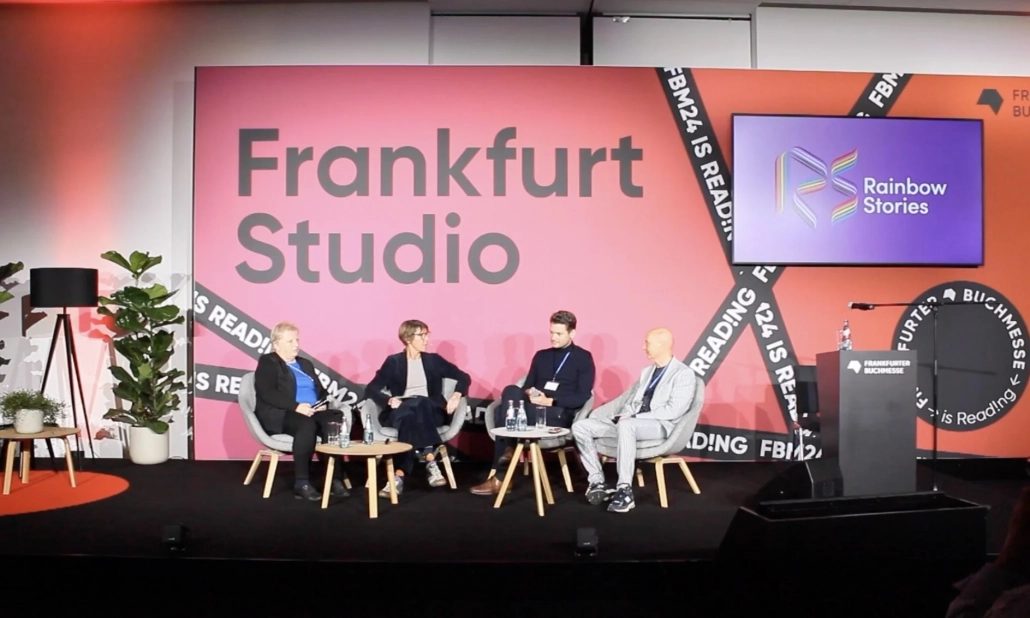
“Grundgesetz auf dem Prüfstand: Finden queere Geflüchtete künftig noch Schutz in Deutschland?” was the title of an event organized by Rainbow Stories and AIDS-Hilfe Frankfurt with the participation of Just Human on 18 October 2024 at the Frankfurt Book Fair 2024.
Katja Walterscheid, psychologist and chair of Just Human, spoke on the panel about lesbian women who fled to Greece and are supported there by Just Human. Many of them experience persecution and violence both in their countries of origin and during their flight, as well as in the country of refuge. Speaking about their sexual orientation is therefore associated with great fear for many. Talking about the violence they experienced and about their own sexual orientation is often only possible after several months — after months spent in safe accommodation, with psychological support and legal assistance.
Afterwards, moderator Bettina Böttinger spoke with Dr. Jonathan Leuschner, lawyer and specialist in asylum and residence law, about the current border controls, the planned Common European Asylum System (CEAS) at the EU’s external borders, and calls for open violations of the law by politicians from the so-called political center.
The conversation with Dr. Jonathan Leuschner can be seen in the video below.
Participants:
- Katja Walterscheid, psychologist and chair of Just Human e. V.
- Dr. Jonathan Leuschner, lawyer and specialist lawyer for asylum and residence law
- Knud Wechterstein, coordinator Rainbow Refugee Support, AIDS-Hilfe Frankfurt e. V.
Support for LGBTIQ+ refugees
At just human, we repeatedly receive desperate emergency calls from LGBTIQ+ refugees. In Athens, many are unable to pay either the rent for sleeping places or for food. The consequences of homelessness are violence and all forms of exploitation. People who have escaped exclusion and persecution in their countries of origin are once again forced to fight for their lives.
just human supports LGBTIQ+ refugees individually in emergency situations and, in some cases, provides longer-term monthly assistance to LGBTIQ+ refugees who would otherwise be completely destitute — for example for safe sleeping places or legal assistance. Medical and therapeutic support is also funded, for example for the treatment of physical and psychological injuries caused by violence and persecution, as well as to ensure the continuation of hormone therapies.
just human provides support as far as financial resources allow. To enable more assistance, we ask for donations for LGBTIQ+ refugees.
Further information on:
Your donation has a direct impact
100% of your donation is passed directly on to LGBTIQ+ refugees in need.
Your support makes possible, among other things:
- safe accommodation
- medical treatments
- psychological support
- legal assistance
REPORTS FROM LGBTIQ+ REFUGEES IN ATHENS
Trigger warning! The texts contain descriptions of violence.
In May 2022, Ronja Narr interviewed two LGBTIQ+ refugees during her internship. Emma and Dian, whose names were changed for security reasons, briefly report years of experiences with violence.
Emma: Violence, transphobia, drugs, suicide
“Moria was like a jungle”
Emma arrived on Lesbos, Greece, in 2017. She lived in the Moria camp and described the conditions there as “like a jungle.” She was exposed to violence and had no house or apartment where she could live. After a suicide attempt, she decided to return to Turkey. Together with friends, she stole a boat.
Street in AthensMany people in Turkey are very transphobic. She did not get a job, she was insulted on the street, and she was again unable to rent a house or apartment. When she stayed with a friend, the neighbors called the police and claimed she was a pedophile.
She therefore set out once again for Greece, again by boat. When they arrived on Lesbos, Emma and her friends were arrested and accused of human smuggling. The phone she owned at the time is still in the possession of the police.
After she was released, she was supported by a group of people and was able to stay in a house. She then made her way to Athens in search of a job, a passport, and a better life. But here, too, she is not happy. She receives no medical support, and when new employers learn that she is trans, she is usually asked to leave immediately.
Receiving help is difficult; many organizations cannot support her, and continuing her hormone therapy is almost impossible. Therefore, she now just wants to leave Greece.
If she could change something about Athens, she says she would ban all drugs — including alcohol.
Emma contacted just human at the beginning of 2022 and received support with her hormone therapy and legal assistance.
Dian: LGBT, woman, flight, rape
“I came here to recover, to be free, and not to be held captive by anyone.”
Dian is 37 years old and comes from Iran. She has been in Greece for 2.5 years. In Athens, she says, she likes it very much; the people here are very nice. However, she has had too many bad experiences here.
When Dian arrived in Athens, she lived for a while in an apartment with two couples and two women. In order to pay the rent, she cleaned for one of the couples. This allowed her to save a little money. After some time, the couple left the country, and she tried to rent an apartment on her own. To afford this, she looked for a roommate. However, as this roommate was not particularly tidy and clean, she soon looked for a new roommate. At the time when the new roommate moved in, she had no money and no job.
The roommate offered to cover all the costs, and because of her financial situation, she accepted the offer. At night, he came to her and raped her. She had nowhere to go and had to continue her life. Afterwards, she said, she no longer had any strength. Life felt like a line she had no influence over.
Every morning she woke up and felt the man’s eyes on her.
After a short time, she contacted the landlord and asked for a new apartment. She also asked him for work. He offered that she could work for him. Since she knew the landlord and now employer, she worked very hard and recruited many new clients as tenants for his apartments. She tried to be strong.
One day, the landlord asked her if she could come to a new house. When she arrived, there was only one other man there besides her — the one mentioned before. He tried to persuade her to wait for the landlord with him. He talked to her and brought her beer, pulled her into the bedroom and locked the door. Dian was afraid, also afraid of losing her job. When he began to take off her clothes, she fell into a kind of shock paralysis — “it felt like a phobia.” She could not move or say anything.
When she told the landlord that she would go to the police, he told her that she had to vacate her apartment by the next day.
She went to an organization that, after a conversation with a psychiatrist, prescribed her medication. No further help was offered.
“If you don’t have asylum, no one helps you.”
In the meantime, she was able to apply for documents and asylum and has now, after one year and eight months, received a positive asylum decision. Dian works on an assembly line in a company. Nevertheless, she is unsure whether she wants to stay here.
Dian contacted just human in December 2020. In order to ensure safe housing, she received monthly support with a rent subsidy. Since she found permanent employment, she has been able to cover her living expenses and rent on her own.
Dian wishes that more people would inform themselves about the situation of women in Iran and Afghanistan. For this purpose, she shared two recommendations with us, both of which can be found on YouTube:
Music video: Mojgan Azimi – Ayeh
Film with English subtitles: The Stoning of Sorya M (2008)
Information & Media
- 🎬 “Fluchtgrund Liebe” – film by Just Human (2019)
- 🌍 Information on the legal situation of LGBTIQ+ people worldwide